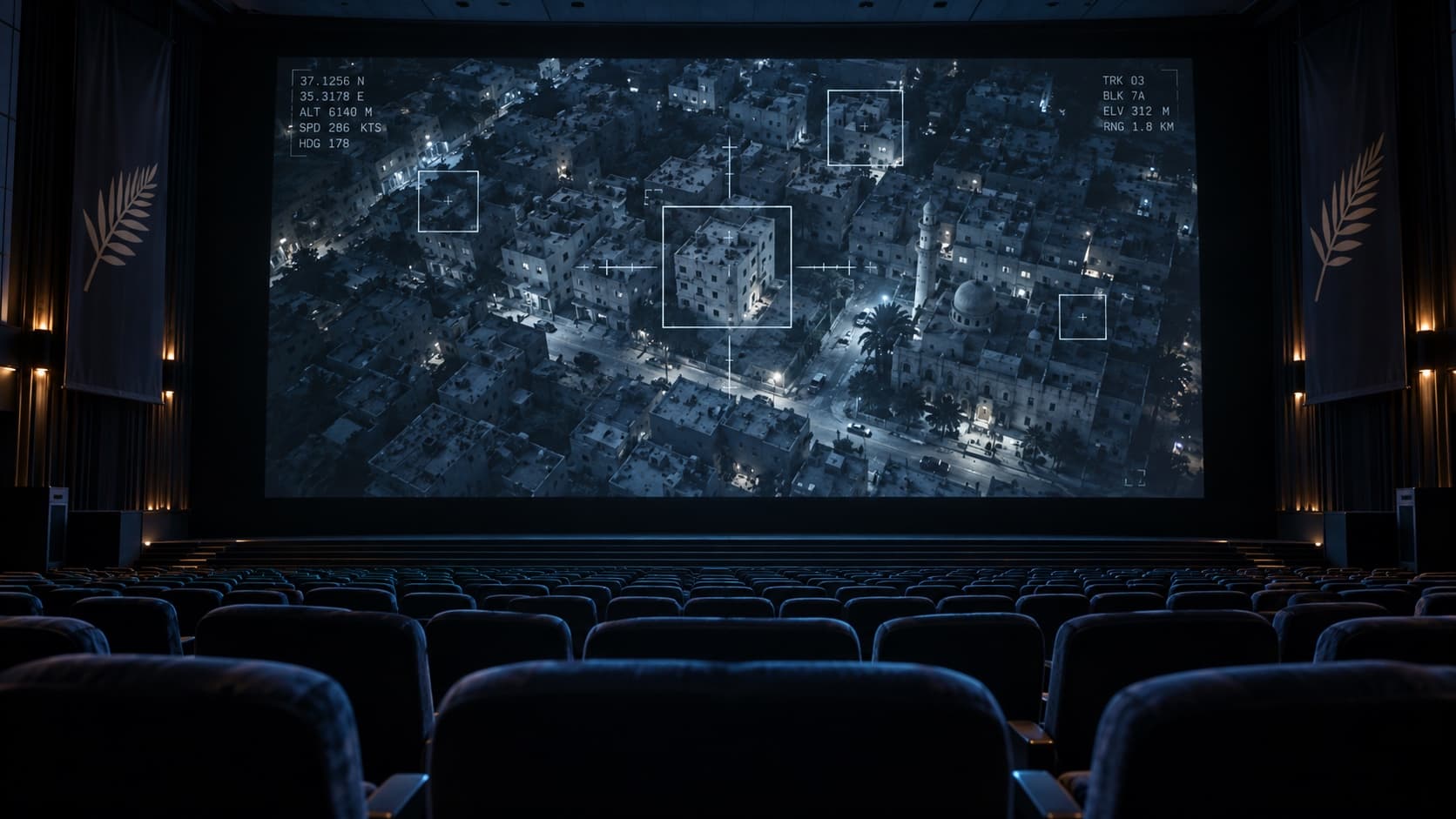
What is established. "NAZA" is an 80-minute documentary directed by the Israeli filmmakers Yuval Abraham and Rachel Szor, who won the 2025 Academy Award for "No Other Land". It premiered in the main competition of the 83rd Venice International Film Festival on September 10, 2026, and received a standing ovation that festival reporters timed at about 25 minutes. On September 12, 2026, the festival jury gave it the Special Jury Prize. The film is a British production made by The Guardian and James Wilson's JW Films, with Jonathan Glazer as executive producer; international sales are handled by MK2 Films, and screenings are scheduled for San Sebastián (September 18–26) and the New York Film Festival (September 25–October 12). The title is the IDF's Hebrew shorthand for "nezek agavi", collateral damage: the number of civilians a planner expects an airstrike to kill.
What the film claims. According to the filmmakers and the reviews published from Venice (Deadline, Variety, The Hollywood Reporter, Screen), the film is built on interviews with 24 Israeli soldiers and intelligence officers who spoke on condition of anonymity. They describe an AI-assisted targeting system, referred to as "Lavender", that drew on Gaza's monitored telecommunications to generate suspected-militant targets; permitted civilian-casualty thresholds per target that, the interviewees say, rose over the war until "20 becomes the norm" for a low-level suspect; strikes on family homes authorised with those expected casualties; and shootings in designated no-go zones near aid distribution sites. The directors say the mass killing was "systemic: not by accident, but by design". Reuters quoted one interviewee describing a phrase like "daddy's home" detected on a child's phone as sufficient to trigger a strike. These are the film's claims, carried by anonymous testimony; this desk has not seen the underlying interviews and cannot verify the identities, ranks, units or dates the interviewees cover.
What is documented from before the film. In April 2024 Abraham published, in +972 Magazine and Local Call with The Guardian, an investigation based on six anonymous intelligence sources describing "Lavender" and reporting that the system had marked some 37,000 Palestinians as suspected militants. The IDF's response at the time, quoted by JTA and The Guardian, said its analysts use information systems as tools, that it does not use an AI system that identifies operatives or predicts whether a person is a terrorist, that it assesses "expected military advantage and likely collateral damage" before every strike, and that it rejected "any policy to kill tens of thousands of people in their homes". The film extends that 2024 reporting from six sources to 24 and adds the collateral-damage thresholds and the aid-site zones. The Times of Israel notes that parts of the earlier reporting "have been challenged by the Israel Defense Forces".
The response. On September 11–12, 2026, the IDF said it "categorically rejects" the allegations, criticised the use of anonymous testimonies whose identities "cannot be verified", said claims about "national and military strategy" exceed what junior soldiers can know, and stated that "the selection and approval of Gaza strikes [were] made by human personnel only … and not by artificial intelligence". It repeated that it "tried to avoid killing civilians" and that Hamas embedded its operatives and infrastructure among the civilian population, and it rejects all accusations of genocide. Former prime minister Naftali Bennett called the film "a horrific blood libel against our sons and daughters". Abraham answered the military's criticism with: "It seems like an attempt to not face reality", and called the reporting "rigorous". This desk found no Foreign Ministry statement as of September 13, 2026.
How it is spreading, and by whom. Three distinct streams carry the film. First, the film's own campaign: The Guardian as producer, festival press, and the directors' acceptance remarks ("It's our country that is doing these crimes"). Second, outlets that convert the testimony into a settled finding: RT ran "Israel used AI to kill thousands of Palestinians in Gaza – documentary"; Al Jazeera filed its coverage under "Crimes Against Humanity"; the activist site Daily Kos headlined "the Gaza genocide"; the conspiracy site The People's Voice ran "Insanely fun video game: Israeli soldiers describe slaughtering thousands". Third, the counter-stream, which dismisses the film wholesale as "blood libel" without engaging the testimony. A figure of "up to 70,000 human targets" circulates in the second stream; this desk could not trace it to a verifiable statement in the film and the only figure with a documented origin is the 37,000 of the 2024 investigation. Do not repeat 70,000 as a fact.
Assessment (Lions of Zion). Legitimate criticism is not propaganda because it is severe, and testimony from serving or former soldiers is a recognised form of journalism whose anonymity is normal. Two things are nevertheless true at once. The film cannot be checked by an outside reader: the sources are anonymous, the thresholds are recollected rather than shown in documents, and the film does not publish the orders it describes. And the IDF's denial is a blanket institutional statement that does not engage the specific thresholds or dates, and the same institution's own inquiries in 2025–2026 have acknowledged serious failures elsewhere. The resolution state is therefore disputed, not refuted and not verified. The claim that AI selected targets without human approval is contradicted by the IDF and, notably, not what the 2024 reporting said either: the sources then described humans approving machine-generated lists quickly, which is a claim about oversight, not about autonomy. The claim that civilian deaths were budgeted into strikes on homes is a claim about proportionality thresholds, which only documents or a judicial process can settle.
What a reader can do. Separate three propositions when this film is cited: that an AI-assisted database existed and shaped target lists (reported by multiple sources since 2024, characterised differently by the IDF); that permitted civilian-casualty thresholds were set and rose (asserted by anonymous testimony, denied as policy); that killing was intentional by design (the film's conclusion, not a documented finding). Ask which of the three a post is actually claiming, and whether it cites the film, the 2024 reporting, or nothing.
Still open / watch next. Whether any interviewee goes on the record; whether the directors publish documents; whether the Military Advocate General or a court addresses the thresholds; the film's Israeli release; whether a Foreign Ministry or government statement follows Bennett's; and how the 70,000 figure propagates.
Last checked: September 13, 2026.